
A Polling Day That Defied the Night’s Dark Omens
The phone had glowed through the darkness—message after message, each one a fresh wound. Ballot boxes violated before dawn. Money changing hands in shadowed corners. Fists and threats. The virus of manipulation seemed to have infected every political body, metastasizing without prejudice. By first light, the prognosis appeared terminal.
Yet Dhanmondi Government Girls High School told a different story.
The streets themselves bore witness to the transformation. Where party festoons typically choked the thoroughfares, where banners normally screamed their tribal allegiances from every lamppost and corner, there was—nothing. The Election Commission’s ban had stripped the visual cacophony from our streets, revealing the city beneath. It was disorienting at first, this absence. We had grown so accustomed to the garish proclamations of political territory that the clean lines of Dhanmondi felt almost sterile. But there was something else in that emptiness: possibility. The city had been returned to its citizens, if only temporarily. The silence of the walls spoke louder than a thousand proclamations.
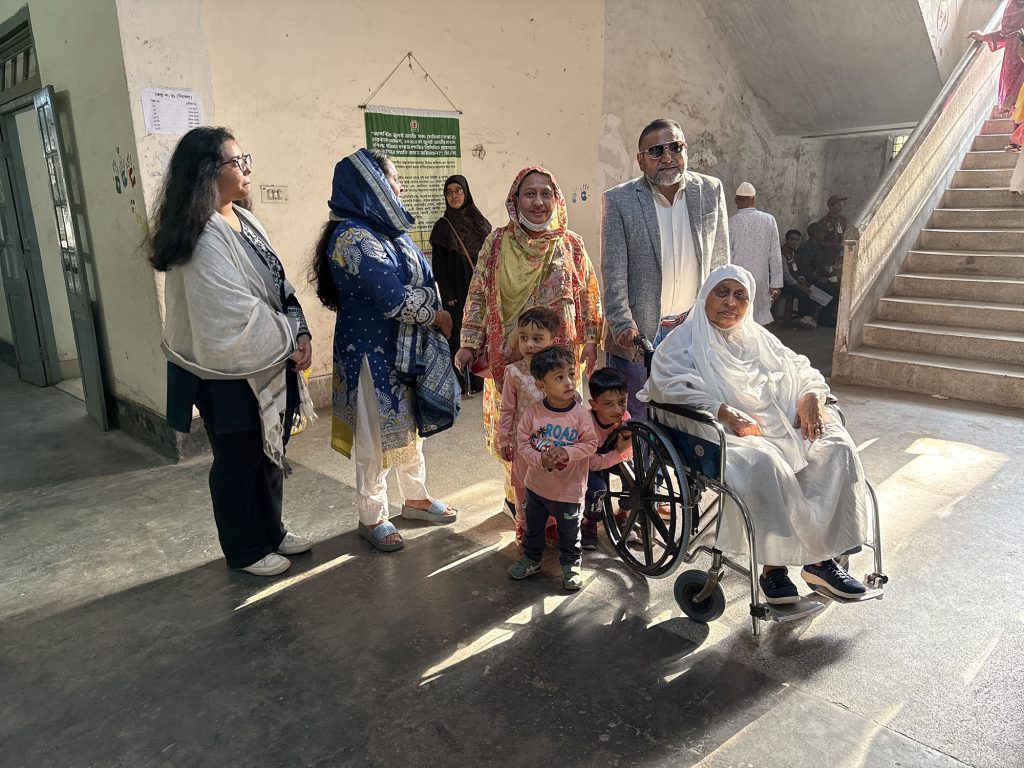
An 86-year-old woman arrived in her wheelchair, a matriarch flanked by great-grandchildren who steadied her journey toward the ballot box. Young families navigated the queue with infants balanced on hips, the children oblivious to the historical weight of the moment. Couples walked in side by side, hands interlocked—the polling station transformed into an unlikely site of communion rather than combat.
The security apparatus was visible but unmarked by tension. Police officers and military personnel stood in postures that suggested vigilance without aggression. Election officials moved with deliberate care, taking time—actually taking time—to demonstrate how to fold the ballot paper. The white one, crowded with party symbols, familiar hieroglyphs of our fractured politics. The pink one, stripped to its essence: yes or no. The referendum as democratic distillation.
The absence of a credible candidate remained Dhanmondi’s unspoken grief. And yes, news filtered in of a death in Sylhet—a single life, which is to say, one too many. But within the frame of reference we’ve inherited, within the catalogue of electoral violence that forms our institutional memory, this day registered as an anomaly.
The questions that had haunted us for months found their answers in the ordinary choreography of citizens exercising franchise. Will there be an election? Yes. Will it be stolen before it begins? Apparently not here. Will blood be the price of participation? Not in this queue. Will those tasked with protection become predators? Not today.
The Interim Government’s report card remains mixed, marked by failures that cannot be erased. But this milestone—the single most consequential test of their legitimacy—they had navigated. Assuming the count remains honest. Assuming the night doesn’t reclaim what the day achieved.
The turnout was modest, perhaps even disappointing. But that misses the point. After decades of manufactured consent and orchestrated spectacle, the people of Dhanmondi had been granted something more precious than high participation numbers: the simple, radical dignity of choice.
Too much blood has soaked into this soil for us to settle for anything less.

Leave a Reply
You must be logged in to post a comment.